
Inicio – Blog
A Clinical Update That Public Health Cannot Ignore
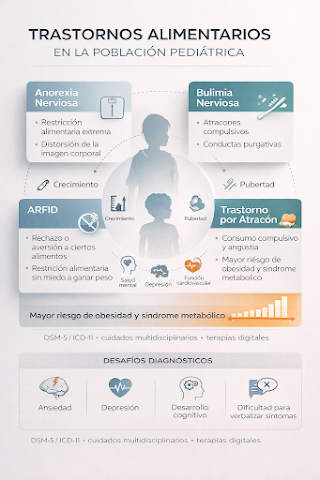
When discussing childhood nutrition, public debate often focuses on obesity while overlooking another critical part of the problem: pediatric eating disorders. The review published in Nutrients in May 2025 reminds us that anorexia nervosa, bulimia nervosa, binge-eating disorder, and ARFID represent complex diagnostic and therapeutic challenges due to their early onset, psychiatric comorbidities, and their potential to compromise growth, puberty, bone health, cardiovascular function, and psychological well-being. The article synthesizes literature published between 2018 and 2024 and highlights the need for integrated, multidisciplinary models of care.
From a medical perspective, anorexia nervosa is characterized by food restriction, intense fear of gaining weight, and clinically significant low body weight; bulimia nervosa by binge-eating episodes followed by compensatory behaviors; binge-eating disorder by recurrent episodes of excessive food intake accompanied by loss of control and absence of purging behaviors; and ARFID (Avoidant/Restrictive Food Intake Disorder) by restrictive eating not driven by body image concerns, but rather by sensory aversion, fear, or lack of interest in eating. The review emphasizes that diagnosis in pediatric populations may be more difficult because of cognitive development, limited ability to verbalize symptoms, and overlap with anxiety, depression, or other psychiatric conditions. It also notes that binge-eating disorder increases the risk of obesity and metabolic syndrome, directly connecting the fields of eating disorders and childhood obesity.
Methodologically, this is a narrative review that updates recent diagnostic and therapeutic evidence, including changes in DSM-5 and ICD-11 classifications, psychometric tools, and advances in cognitive behavioral therapy, family-based treatment, and digital treatment modalities. Its value for public health lies in rejecting the false separation between “mental health” and “nutrition”: eating disorders are both. In clinical practice, focusing only on weight without exploring eating behaviors, body image, or emotional suffering may actually worsen the condition.
My interpretation is that pediatric prevention strategies must protect children not only from excess weight, but also from the harm caused by restrictive dieting, body stigma, and oversimplified messages about nutrition. A modern public health policy should promote healthy habits without humiliation, prevent obesity without triggering high-risk eating behaviors, and train healthcare professionals to recognize anorexia, bulimia, binge-eating disorder, and ARFID at an early stage. In preventive pediatrics, it is not enough to talk about calories; we must also talk about behavior, development, and dignity.
Scientific or Institutional Source
Horovitz, Advancements in the Diagnosis and Treatment of Eating Disorders in Children and Adolescents: Challenges, Progress, and Future Directions, Nutrients (2025).
